SDTDEV 143: Positive Psychology
Transforming an Instructor-Led Course into an Interactive Online Learning Experience
Overview
I led the end-to-end design and development of SDTDEV 143: Positive Psychology, transforming an existing face-to-face course into a fully online learning experience for BYU Online.
Starting primarily with faculty PowerPoint slides and subject-matter expertise, I redesigned the course around active learner engagement, developing interactive activities and selecting technologies that allowed students to explore, practice, discuss, reflect on, and apply positive psychology concepts online.
When my supervisor transitioned to another position early in the project, I assumed ownership of the course design and worked directly with the faculty subject-matter expert while coordinating with media production, editing, accessibility, and copyright teams. I completed the course in time for its Fall 2023 launch and later partnered with the faculty member to refine the course based on his teaching experience.
Screenshot of the Home Page of the STDEV 143 Positive Psychology Online Course

The Challenge
01 — From Content to Experience
How might I transform presentation-based content into an engaging online learning experience?
The source materials consisted primarily of faculty PowerPoint slides developed for face-to-face teaching. While they communicated the subject matter, they offered limited opportunities for student-content interaction in an asynchronous environment.
My challenge was to move beyond simply transferring slides online and design opportunities for learners to interact, practice, reflect, discuss, and apply what they were learning.
02 — Translating Face-to-Face Learning Online
How might I preserve the value of learning experiences that do not naturally translate online?
Some positive psychology concepts and classroom activities depended heavily on instructor facilitation, discussion, reflection, or social interaction.
Rather than replicating these activities literally, I examined the learning purpose behind each activity and redesigned the experience for an online environment.
03 — Taking Ownership in a Changing Team
How might I move a complex course from concept to launch while coordinating multiple stakeholders?
Two months after I joined BYU Online, my supervisor transitioned to another position. I took the responsibility for moving the course forward, working directly with the faculty SME and coordinating with media production, accessibility, editing, and copyright teams.
I managed the course through development and quality review and completed the design before its Fall 2023 launch.
My Role
-
Lead Learning Experience Designer
-
End-to-end course design
-
Faculty/SME collaboration
-
Learning activity design
-
LMS development
-
Multimedia planning
-
Cross-functional project coordination
-
Quality assurance
-
Post-launch iteration
As the primary learning designer, I served as the bridge between the faculty SME and production teams—translating instructional goals into design requirements, coordinating deliverables, incorporating feedback, and keeping the course moving toward launch.
Design Process
Empathize
I reviewed the faculty's existing materials to identify learning objectives, challenging concepts, opportunities for interaction, and activities that depended on face-to-face instruction. I then matched each learning need with an appropriate online learning strategy rather than selecting technology first.
Design Decisions
1. From Passive Content → Interactive Practice: H5P Interactive Learning
Need: Students needed opportunities to interact with concepts rather than passively review presentation content.
Design: I developed H5P experiences including varied interactive quizzes, interactive books, and image galleries.
Why: These interactions created opportunities for learners to explore concepts, check their understanding, and engage with course content throughout the learning experience.
Screenshot of one the interactive quizzes made by H5P

Screenshots of two interactive books integrated in the modules made by H5P


2. From Classroom Conversation → Video-Based Discussion: GoReact
Need: Some face-to-face activities depended on discussion and personal expression that could easily be lost online.
Design: I incorporated video-based discussion through GoReact, giving students opportunities to communicate ideas and respond in a richer format than text alone.
Why: Video helped preserve elements of social presence and personal communication from the original classroom experience.
Screenshots of the video-based discussion made by GoReact


3. From Passive Reading → Active Reading: Perusall
Need: Simply assigning readings did not guarantee meaningful engagement with the material.
Design: I integrated Perusall to turn reading into a collaborative, active learning experience.
Why: Students could annotate, question, respond, and engage with ideas while reading rather than waiting until after the reading to discuss them.
Screenshots of the Active Reading made by Perusall


Screenshot of the inside of Perusall with reading assignments list

Screenshot of one of the reading assignments with students' social annotations

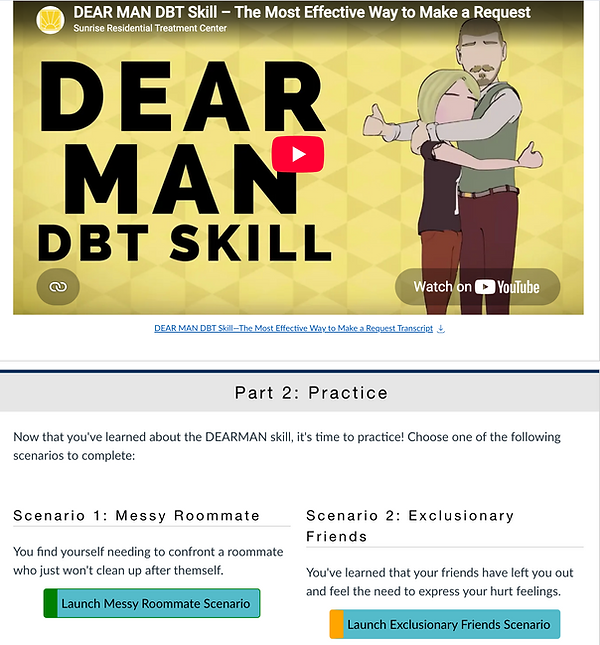
4. From Abstract Concepts → Reflection & Application: SmartBuilder
Need: Positive psychology requires learners to connect theoretical concepts with personal experience and authentic situations.
Design: I used SmartBuilder to create structured reflection and discussion experiences that guided students through applying course concepts.
Why: The activities shifted learning from knowing about positive psychology toward using positive psychology concepts.
Screenshot of one of the Reflection activities made by SmartBuilder

Outcomes
The complete online course was successfully designed and developed in time for its Fall 2023 launch.
The project:
-
Transformed presentation-based faculty materials into an interactive online learning experience.
-
Introduced multiple forms of student-content, student-student, and reflective interaction.
-
Integrated H5P, GoReact, SmartBuilder, and Perusall based on specific learning needs rather than technology for its own sake.
-
Successfully coordinated contributions across faculty, media, accessibility, editing, and copyright teams.
-
Received positive feedback from the faculty SME.
-
Continued to evolve after launch as I worked with the faculty member to incorporate insights from his subsequent teaching experience.
Evaluate & Refine
I treated launch as the beginning of the next design cycle rather than the end of the project. After the faculty member gained additional experience teaching the course, we revisited the online design together and identified opportunities for improvement. I incorporated his new insights into subsequent revisions, allowing the course to continue evolving based on authentic teaching experience.
Technology Skills
Canvas LMS, HTML, H5P — interactive quizzes, books, and image galleries, SmartBuilder — interactive reflection and discussion activities, Perusall — collaborative annotation and active reading, GoReact — video-based discussion and learner interaction, Multimedia storyboarding, Animated video planning, Accessibility review and remediation, Copyright and permissions coordination, Content editing and quality assurance.
What I Learned
Designing SDTDEV 143 taught me that moving learning online is not a matter of converting content from one format to another. It requires identifying what makes an existing learning experience effective and intentionally redesigning those interactions for a new environment.
Starting with primarily PowerPoint-based materials pushed me to think beyond content delivery and ask what learners should do with the content. This led me to design opportunities for practice, discussion, active reading, reflection, and application using different technologies according to their instructional purpose.
The project also strengthened my ability to take ownership in an evolving environment. When the team structure changed, I learned to independently manage the design process, build a strong partnership with the faculty SME, coordinate specialized teams, and move a complex project from early development through launch and continued iteration.