Intro to Business Online Course
Designing an Accessible, Integrative Business Learning Experience for Non-Business Majors
Overview
I co-designed a 3-credit asynchronous Intro to Business course for BYU Marriott Business School, created specifically for students outside the business school. The course introduced learners to six core business functions, four business disciplines, and four supporting topics while helping them understand how these areas work together in authentic business contexts.
Unlike a traditional survey course focused primarily on exposing students to individual business topics, our goal was to help students learn business principles, apply business skills, and develop integrative thinking through real-world problem solving.
My contributions focused particularly on designing the accounting and personal finance learning experiences, developing asynchronous learning activities and assessments, and designing opportunities for students to apply business concepts to industries relevant to their own interests.

The Challenge
01 — From Expert Knowledge to Learner-Ready Content
How might we transform dense expert content into an accessible introduction for non-business students?
Unlike projects where faculty provide ready-to-use slides or course materials, much of the content for this course had to be developed through direct collaboration with subject-matter experts, and be the subject-matter experts ourselves. Across the course, our design team worked with 12 SMEs, each bringing different levels of availability, online teaching experience, and familiarity with the project.
I was responsible for the accounting and personal finance modules. Accounting is one of the densest subject areas in the course. There was no ready-to-use faculty PowerPoint deck. After reaching out to the accounting faculty, the primary materials I received were several hour-long instructional videos.
The challenge was not simply transferring that material into Canvas. I had to view the videos, read the textbook, and other resources to determine:
-
What does a non-business student actually need to understand about accounting?
-
Which concepts and skills are essential?
-
What can realistically be learned within two weeks?
-
How should complex information be sequenced for novices?
-
What should be required, and what should become optional?
-
Where do students need opportunities to practice rather than simply read or watch?
That became a content curation and learning experience design problem, not merely a content-development task.
02 — From Business Topics to an Integrated Business Experience
How might students understand how business functions work together rather than learn them as isolated subjects?
The course covered a wide range of disciplines, creating the risk that students would experience it as a collection of disconnected topics. Our design therefore emphasized integrative thinking. Students were expected not only to identify business principles but to apply them to organizations, products, industries, and real-world problems.
The challenge was to create activities and assessments that repeatedly helped students connect individual functions to the larger business system.
03 — Consistency Without Sameness
How might a course designed with many SMEs feel like one coherent learning experience?
Each business discipline had different content, instructional needs, and faculty expertise. At the same time, students needed predictable navigation, workload, and expectations in a large asynchronous course.
We therefore designed modules around a consistent but flexible structure:
Introduction → Content → Assignments
Consistent structures, assignment patterns, and due dates helped reduce unnecessary cognitive load, while individual topics retained flexibility for discipline-specific content and activities.
My Role
Learning Experience Designer
-
Accounting modules design
-
Personal finance models design
-
Content analysis and curation
-
SME collaboration
-
Learning objective alignment
-
Instructional video planning and segmentation
-
Canvas module development
-
Case-based learning design
-
Discussion design
-
Quiz and assessment design
-
Personal industry project design
-
Asynchronous learning experience design
-
Integrative assessment design
-
Iterative prototyping and revision
I worked at the intersection of faculty expertise, learner needs, and course-level design, translating specialized business knowledge into accessible learning experiences for students without a business background.
Design Process
Empathize
Designing for Learners Outside the Business School
The target audience was not accounting or business majors. The course was intentionally designed to make foundational business knowledge accessible to students from other disciplines. This fundamentally shaped my approach to the accounting modules. Instead of asking, "What does an accounting professor typically teach?" I needed to ask, "What does a non-business student need to understand and be able to do with accounting knowledge?" That distinction guided my content selection, sequencing, examples, assessments, and decisions about what to leave out.
From Faculty Expertise to Learning Experience
My Accounting Design Process
Connect with Accounting SME Review Hours of Instruction Videos Read & Analyze Textbook Content
Identify Essential Concepts & Skills Prioritize Required vs. Optional Content Sequence Content Across Two Modules Segment Long Lectures into Short Videos Design Mini Cases, Discussions & Quizzes
Build the Learning Experience in Canvas
Design Decisions
1. From Dense Content → Essential Learning: Content Prioritization
Need: Accounting is a complex discipline, but students had only one week to develop foundational understanding.
Design: I reviewed faculty videos and textbook materials to identify the most important terminology, concepts, and skills for non-business undergraduate learners. I then organized content into three levels:
Essential: Concepts every student needed to understand.
Supporting: Information needed to reinforce or contextualize essential concepts.
Optional: Useful deeper content that interested learners could explore without increasing the required workload.
Why: Effective learning design is not about including everything an expert knows. It requires making deliberate decisions about what learners need now, what can wait, and what best supports the learning outcomes.
2. From One Dense Topic → One Scaffolded Module: Content Sequencing
Need: Accounting contained too much foundational material to be treated as a single weekly topic without overwhelming novice learners.
Design: I divided accounting into two sections within one module, sequencing concepts so that students could establish foundational knowledge before progressing to more complex applications.
Why: Breaking the content into a progressive learning sequence allowed students to build on prior understanding rather than encountering a large amount of unfamiliar terminology and concepts simultaneously.
3. From Hour-Long Lectures → Focused Microlearning: Instructional Video Redesign
Need: The available faculty materials included several hour-long instructional videos that were not well suited to the pacing and cognitive demands of an asynchronous introductory course.
Design: I reviewed the videos to identify the most important concepts and skills, then planned shorter instructional segments of approximately seven minutes or less, each centered on a focused learning purpose.
Instead of 60-minute faculty lecture, I designed:
Concept 1 Asset=Liability+Owner's Equity → 6 min video
Concept 2 Balance Sheet → 9 min video
Concept 3 Income Statement → 7 min video
Concept 4 OE=CS+RE and RE=BB+NI-Div → 5 min video
Concept 5 Statement of Cashflows → 9 min video
Skill 2 Sales Revenue – Variable Costs – Fixed Costs = Profit → 7 min video
Why: Shorter, focused segments made complex accounting content easier for novice learners to process and allowed instructional videos to be integrated directly with practice and application.
4. From Watching → Applying: Mini Case Studies
Need: Students could memorize accounting terminology without understanding how accounting information informs actual business decisions.
Design: I developed mini case studies that required students to interpret concepts in realistic business situations.
Why: Cases shifted the learning experience from, "Do you remember this accounting concept?" to "Can you use this concept to understand a business problem?" That better aligned with the broader course goal of applying business principles and skills in authentic contexts.
5. From Passive Study → Multiple Forms of Practice: Discussions + Quizzes + Application
Need: A large asynchronous course needed scalable ways for students to practice, receive feedback, and interact without creating an unrealistic grading burden for instructors and TAs.
Design: The course incorporated different forms of asynchronous assessment, including:
-
Auto-graded quizzes with feedback
-
Individual core-function assignments
-
Personal project discussions
-
Integrative assessments
-
Midterm and final assessments
-
Team projects
The assessment strategy intentionally included learning activities ranging from lower- to higher-order thinking based on Bloom's Taxonomy.
Why: Not every learning objective requires the same kind of assessment. A combination of automated knowledge checks and authentic application activities supported both scalability and deeper learning.
6. From Generic Examples → Personally Relevant Application: Personal Industry Discussion
This is another section I would emphasize because the slides specifically identify this as your contribution.
Need: Students came from majors outside the business school. Generic business examples could make the material feel disconnected from their own professional interests.
Design: I designed a personal industry discussion that allowed students to apply each core business function to an industry or business relevant to them.
The activity evolved through several iterations—from individual application of business principles to a design where students with similar industry interests could work together and analyze how different business functions operate within that context.
Why: Personalization made business concepts more relevant while peer interaction exposed students to different perspectives and applications.
Build
Course Architecture
A carefully sequenced course architecture balanced individual business functions with recurring integrative learning experiences.
The schedule was deliberately designed to provide balanced time across topics while supporting sequential understanding, consistent course flow, and predictable due dates.
Accounting and Personal Finance Learning Journey
Screen recording of the course structure
Screenshot of overall accounting learning module

Screenshot of overall personal finance module

Screenshot of overall accounting learning journey with time estimate of instructional videos, readings, and each learning activities
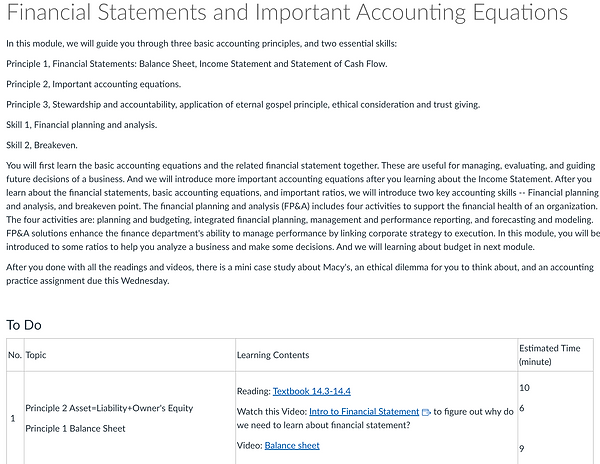


Screenshots of the Mini case study

Screenshots of the Accounting practice application learning activity


Screenshots of the personal project discussion


Outcome
The project began as part of an Advanced Experience Design course and internship and evolved into a fully developed asynchronous course for non-business students.
The stakeholders were pleased with the final design, and BYU Marriott School of Business launched the new course for non-business students in Fall 2022. What began as a design project became an established learning opportunity that has continued to serve students beyond its initial launch.
The result was a comprehensive asynchronous learning experience that made foundational business knowledge more accessible and meaningful to students outside the business school while helping them understand how different business functions connect and operate together.
Evaluate & Refine
The design process required ongoing iteration as content, SME availability, project constraints, and learning needs became clearer.
Some activities evolved substantially from their original concepts. The Personal Industry Discussion, for example, progressed through multiple iterations before arriving at a more collaborative design organized around students' industry interests.
The project also reinforced the value of prototyping with SMEs. Because many SMEs had limited experience designing online courses, the team provided prototypes rather than asking faculty to create online content from scratch. This gave faculty something concrete to respond to and helped translate disciplinary expertise into consistent online learning experiences.
Technology & Design Skills
Learning Design
Asynchronous Course Design
Learning Activity Design
Assessment Design
Case-Based Learning
Bloom's Taxonomy
Cognitive Load Management
Content Chunking & Sequencing
Content & Multimedia
Instructional Video Planning
Microlearning Design
Content Curation
Storyboarding
Faculty Content Translation
Textbook & OER Integration
Collaboration & Production
SME Collaboration
Cross-Functional Course Development
Prototyping
Quality Assurance
Iterative Design
Learning Technologies
Canvas, Camtasia, Google Workspace, Canva.
What I Learned
Designing the Intro to Business course taught me that one of the most important responsibilities of a learning experience designer is deciding what not to include.
When I began designing the accounting modules, I had hours of expert instruction, extensive textbook content, and only one week of learner time. The challenge was not finding enough content—it was determining which concepts and skills mattered most for students who were encountering accounting for the first time.
This experience strengthened my ability to translate expert knowledge into learner-centered experiences. I learned to listen to SMEs while also viewing their content through the eyes of a novice learner: prioritizing essential information, reducing unnecessary complexity, sequencing concepts carefully, and creating opportunities to apply new knowledge.
The project also taught me that consistency and flexibility are not opposites. A predictable learning structure can reduce cognitive demands while still allowing each discipline to use the activities, examples, and instructional approaches that best support its learning goals.
Most importantly, I learned to evaluate design decisions by asking not "How much content can I include?" but:
"What does this learner need to know, do, and experience within the time available?"
Key Takeaway
Good learning design is not about transferring everything an expert knows. It is about identifying what learners need most and creating the clearest path for them to understand, practice, and apply it.